

Your best source on business and economy news from the United Kingdom
Provided by AGP
Aimei Yang Wins 2026 Gourmand Award, Examines How AI Is Shaping Human Experience in Space Development

Aimei Yang with her award-winning book ART BITE, a work exploring how AI-driven sensory design shapes human experience and engagement in the future of space development.
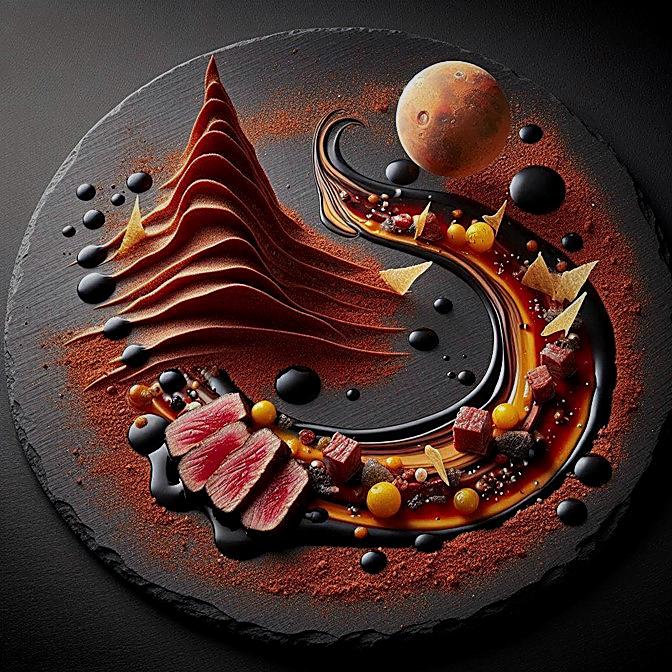
A conceptual dish from ART BITE, illustrating AI-driven sensory design as a system for translating human perception into structured experiences for future space environments

A conceptual orbital system from Aimei Yang’s ongoing work “SPACE BITE,” exploring how AI-driven sensory design may shape human experience in near-Earth orbit environments
From Next Bite to ART BITE, a three-time Gourmand Awards winner exploring how AI reshapes human perception and engagement in space.
pace will not only be engineered—it will be interpreted. The future of space depends on how humans perceive, relate to, and trust it.”
SHANGHAI, SHANGHAI, CHINA, May 4, 2026 /EINPresswire.com/ -- A new constraint is emerging in the race toward long-term human presence in space—not engineering, but human perception. While launch systems, habitats, and infrastructure continue to advance, a more fundamental question is taking shape: how do we, as individuals, come to understand, relate to, and ultimately commit to life beyond Earth?— Aimei Helen Yang
In this context, Aimei Helen Yang has been named a Winner at the Gourmand Awards 2026 in the category of Artificial Intelligence, marking her third consecutive international recognition from 2024 to 2026.
The award recognizes her ongoing work on “Imagination Infrastructure”—a framework that examines how AI is reshaping human perception as societies engage with increasingly complex systems. Rather than treating perception as a passive outcome, the framework positions it as an active layer that can be designed, structured, and aligned—directly influencing trust, adoption, and long-term participation. In space-related contexts, this approach is further explored through what Yang refers to as a “space-art” concept, where sensory design becomes a means of translating unfamiliar environments into human-scale experience.
This shift has immediate relevance for both the AI industry and the space sector. As large-scale systems—from AI platforms to orbital infrastructure—become more complex, their success depends not only on capability, but on whether humans can meaningfully interpret and engage with them. In this context, perception becomes a strategic layer, not a secondary one.
Yang’s award-winning book ART BITE explores this idea through an unconventional but structured approach: using food as a sensory interface to translate unfamiliar environments into human-scale experience. Rather than focusing on cuisine as content, the work treats it as a system for modeling perception—testing how form, texture, and sensory cues can simulate conditions that humans have not yet physically encountered.
This approach points to a broader shift. As space systems and AI platforms grow in complexity, the primary bottleneck is no longer capability, but interpretation. Without mechanisms that allow humans to cognitively and emotionally engage with these systems, technological progress risks outpacing participation. In this context, perception is not a secondary effect—it becomes a design domain.
Yang’s work suggests that sensory design—supported by AI—can function as a “pre-adaptation layer,” shaping how individuals and markets perceive, trust, and engage with the future of space. In this context, imagination infrastructure is emerging as a prerequisite for the space experience economy—particularly in areas such as public engagement, commercial space experiences, and brand trust development. Without such frameworks, the risk is not technological failure, but disengagement.
Reflecting on this shift, Yang notes: “Before humanity settles space, we must first learn how to feel it.”“Space will not only be engineered—it will be interpreted.”
Building on this foundation, Yang is currently developing SPACE BITE, an ongoing research and creative project that extends the concept of Imagination Infrastructure into space environments. The work explores how sensory systems—rather than only life-support systems—may play a role in enabling long-term human presence beyond Earth. Positioned at the intersection of AI, perception, and infrastructure, the project reflects a growing recognition that human experience itself is becoming a design domain in future space systems.
Yang will further engage with these ideas alongside the global space community at the upcoming International Space Development Conference 2026, hosted by the National Space Society. As the sector continues to integrate technological, commercial, and human-centered perspectives, her work contributes to emerging discussions around how perception, narrative, and cultural translation may support sustained participation in a spacefaring future.
About Aimei Helen Yang
She is a strategic communications leader and researcher working at the intersection of artificial intelligence, infrastructure systems, and long-term space development. With nearly three decades of experience advising global organizations—including leadership roles at WPP and Walmart—she specializes in translating complex technological systems into public understanding, market positioning, and long-term trust across cultures. Her work extends into the AI industry, focusing on how large-scale systems shaping human perception and public engagement. She has advised organizations on aligning technological capability with narrative, adoption, and stakeholder trust, particularly in contexts where innovation outpaces public understanding. She is a graduate of MIT’s New Space Economy program, she is the author of Brand for Space and a multi-time Gourmand Awards–recognized creator. Her work, including Futuristic Flavors AI Edition, Next Bite, and ART BITE, applies concept-led design to explore how perception and imagination influence engagement with future systems.
Helen Yang
Shanghai Huamei PR Consulting Co. Ltd
+ +86 135 0185 0749
email us here
Space-Art Cuisine: A Human Interface for Imagining Space
Legal Disclaimer:
EIN Presswire provides this news content "as is" without warranty of any kind. We do not accept any responsibility or liability for the accuracy, content, images, videos, licenses, completeness, legality, or reliability of the information contained in this article. If you have any complaints or copyright issues related to this article, kindly contact the author above.
