

Precious Metals E-Waste Recovery Market to Reach US$ 57.4 Billion by 2033 at 5.4% CAGR Growth Outlook
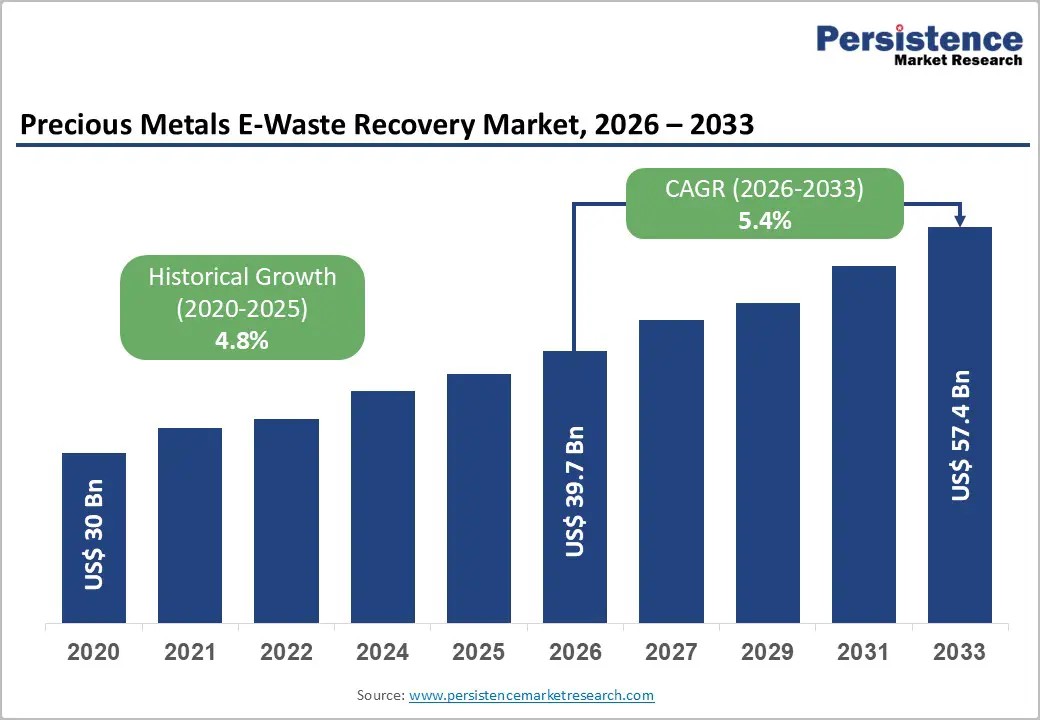
The global precious metals e-waste recovery market is set to reach US$ 57.4 Bn by 2033, growing at a 5.4% CAGR during 2026–2033, driven by recycling demand
BRENTFORD, ENGLAND, UNITED KINGDOM, June 29, 2026 /EINPresswire.com/ -- The Precious Metals E-Waste Recovery Market is growing steadily as electronic waste becomes an important secondary source of valuable metals. The market is valued at US$ 39.7 billion in 2026 and is expected to reach US$ 57.4 billion by 2033, growing at a CAGR of 5.4%. Rising e-waste generation, along with increasing demand for metals like gold, silver, palladium, platinum, and copper, is driving strong growth in urban mining and recycling activities. According to the Global E-waste Monitor 2024, about 62 million metric tonnes of e-waste were generated in 2022, but only a small share is formally recycled, highlighting major growth potential.
Market expansion is supported by rising demand for precious metals across electronics, automotive, renewable energy, and semiconductor industries, along with strict government policies promoting circular economy and EPR frameworks. Gold remains the leading metal segment due to its high value and use in electronic components, while pyrometallurgy is the dominant processing technology because of its efficiency in handling mixed e-waste. Regionally, Asia Pacific leads the market, driven by high e-waste generation, strong electronics manufacturing, and expanding recycling infrastructure in countries like China, Japan, and India.
𝐆𝐞𝐭 𝐚 𝐒𝐚𝐦𝐩𝐥𝐞 𝐏𝐃𝐅 𝐁𝐫𝐨𝐜𝐡𝐮𝐫𝐞 𝐨𝐟 𝐭𝐡𝐞 𝐑𝐞𝐩𝐨𝐫𝐭: https://www.persistencemarketresearch.com/samples/36710
Market Segmentation:
The Precious Metals E-Waste Recovery Market is segmented by metal type, processing technology, source, and application. By metal type, it includes gold, silver, palladium, platinum, copper, and other valuable metals, with gold leading due to its high value and extensive use in electronics, while copper remains important for electrical and industrial applications. Based on processing technology, the market is divided into pyrometallurgy, hydrometallurgy, and biohydrometallurgy, where pyrometallurgy dominates due to large-scale efficiency, while hydrometallurgy and bio-based methods are gaining traction for their lower environmental impact. From a source perspective, IT and telecommunication equipment is the largest segment, followed by consumer electronics, industrial devices, automotive electronics, and medical equipment, driven by short product lifecycles and rising electronic consumption.
Regional Insights:
Asia Pacific leads the global market due to its massive electronics production base, high e-waste generation, and strong recycling initiatives, with China, Japan, and India playing major roles in expanding formal recovery systems. North America holds a strong position supported by advanced recycling infrastructure, strict environmental regulations, and increasing investment in critical material recovery technologies, particularly in the United States. Europe also remains a highly developed region, driven by strict WEEE regulations, circular economy policies, and strong participation from established recyclers in countries such as Germany, Belgium, and France.
𝐃𝐨 𝐘𝐨𝐮 𝐇𝐚𝐯𝐞 𝐀𝐧𝐲 𝐐𝐮𝐞𝐫𝐲 𝐎𝐫 𝐒𝐩𝐞𝐜𝐢𝐟𝐢𝐜 𝐑𝐞𝐪𝐮𝐢𝐫𝐞𝐦𝐞𝐧𝐭? 𝐑𝐞𝐪𝐮𝐞𝐬𝐭 𝐂𝐮𝐬𝐭𝐨𝐦𝐢𝐳𝐚𝐭𝐢𝐨𝐧 𝐨𝐟 𝐑𝐞𝐩𝐨𝐫𝐭: https://www.persistencemarketresearch.com/request-customization/36710
Market Drivers:
The Precious Metals E-Waste Recovery Market is strongly driven by the rapid rise in global electronic waste generation, fueled by increasing use of smartphones, computers, wearables, electric vehicles, and industrial electronics with shorter replacement cycles. This growing volume of end-of-life devices creates a steady and rich supply of metal-bearing waste, making urban mining a cost-effective alternative to conventional mining. The presence of high-value metals such as gold, palladium, platinum, and copper in electronic products further enhances profitability, especially as commodity prices remain elevated. In addition, supportive government policies promoting circular economy models, extended producer responsibility (EPR) frameworks, and domestic sourcing of critical raw materials are accelerating investments in advanced recycling and recovery technologies.
Market Restraints:
Despite strong growth potential, the market is constrained by the dominance of informal recycling systems, particularly in developing economies, where unsafe and inefficient processing methods lead to low recovery rates and environmental risks. The lack of organized collection networks and reverse logistics systems limits the availability of high-quality feedstock for formal recyclers, restricting scalability. Moreover, strict international regulations such as the Basel Convention, along with regional compliance frameworks like the EU WEEE Directive and national e-waste laws, increase operational complexity, documentation requirements, and cross-border trade limitations, ultimately raising costs for industry participants.
Market Opportunities:
Significant opportunities are emerging from technological advancements in hydrometallurgical and biohydrometallurgical processes, which offer higher recovery efficiencies with lower environmental impact compared to traditional smelting methods. Innovations such as non-cyanide leaching and microbial bioleaching are enabling more sustainable extraction of precious metals while improving yield quality. Government-backed initiatives, including the EU Critical Raw Materials Act and U.S. Department of Energy funding programs, are further encouraging domestic recycling capacity expansion. Additionally, the integration of artificial intelligence, robotics, sensor-based sorting systems, and digital traceability solutions is improving operational efficiency, transparency, and overall value recovery across the e-waste supply chain.
𝐁𝐮𝐲 𝐍𝐨𝐰 𝐭𝐡𝐞 𝐃𝐞𝐭𝐚𝐢𝐥𝐞𝐝 𝐑𝐞𝐩𝐨𝐫𝐭: https://www.persistencemarketresearch.com/checkout/36710
Company Insights
• Umicore
• Sims Limited
• Electronic Recyclers International (ERI)
• Stena Recycling
• Veolia
• Aurubis AG
• Boliden Group
• DOWA Holdings Co., Ltd.
• Johnson Matthey
• Heraeus Holding GmbH
• EnviroLeach Technologies Inc.
• TES (TES-AMM)
• Materion Corporation
• Metallix Refining Inc.
• Tanaka Precious Metals
Conclusion
The Precious Metals E-Waste Recovery Market is growing as a key part of the circular economy, driven by rising e-waste, increasing demand for critical metals, supportive regulations, and advancements in recycling technologies. Although challenges like informal recycling, weak collection systems, and regulatory hurdles remain, ongoing innovation and policy support are improving efficiency and profitability. With countries focusing on resource security and sustainability, e-waste-based metal recovery is becoming essential for meeting future demand for strategic metals.
Related Reports:
Automatic Number Plate Recognition System Market
Pooja Gawai
Persistence Market Research
+1 646-878-6329
email us here
Visit us on social media:
LinkedIn
Instagram
Facebook
YouTube
X
Legal Disclaimer:
EIN Presswire provides this news content "as is" without warranty of any kind. We do not accept any responsibility or liability for the accuracy, content, images, videos, licenses, completeness, legality, or reliability of the information contained in this article. If you have any complaints or copyright issues related to this article, kindly contact the author above.
